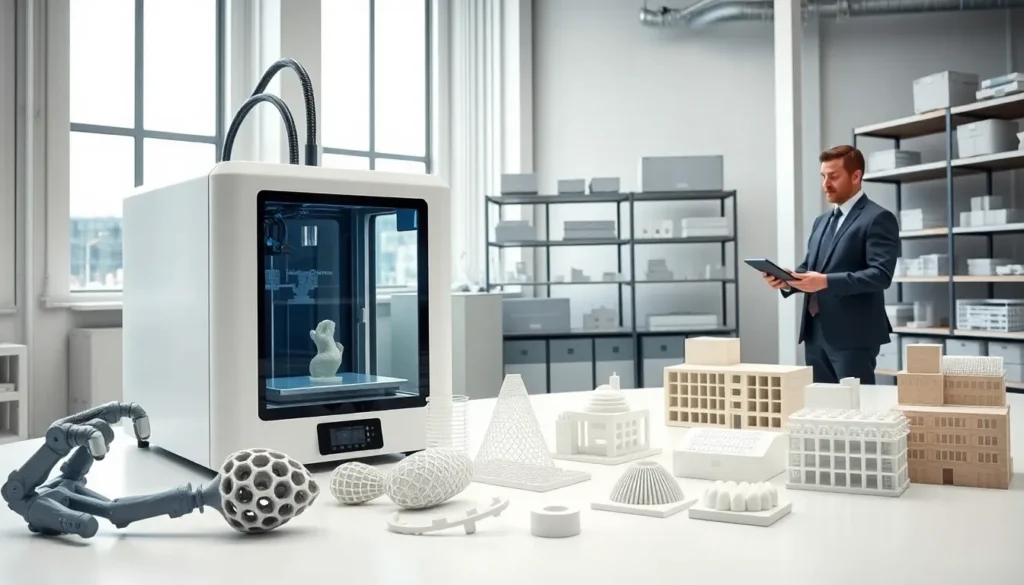
3D printing examples surround us today, from hospital operating rooms to factory floors. This technology creates physical objects layer by layer from digital designs. What started as a rapid prototyping tool now produces everything from human organs to rocket engines. Industries across the board have adopted 3D printing to cut costs, speed production, and build things that traditional manufacturing cannot achieve. The applications keep expanding as materials improve and printers become more precise. This article explores practical 3D printing examples across six major sectors, showing how additive manufacturing delivers real value in 2025.
Table of Contents
ToggleKey Takeaways
- 3D printing examples span healthcare, aerospace, automotive, consumer products, construction, and education—transforming how industries design and manufacture goods.
- In healthcare, 3D printing enables custom prosthetics, dental implants, and bioprinted tissues, with over 90% of hearing aids now produced using this technology.
- Aerospace and automotive companies use 3D printing to create lightweight parts, reduce component counts, and cut production time from years to months.
- Construction firms now print full-scale homes in as little as 24 hours for under $10,000 in materials, making affordable housing more achievable.
- Prototyping costs have dropped dramatically—designs that once required $10,000 and three weeks can now be printed for $50 overnight.
- Maker spaces and libraries provide public access to 3D printing, helping entrepreneurs and students bring product ideas to life without expensive equipment.
Healthcare and Medical Applications
Healthcare stands out as one of the most exciting areas for 3D printing examples. Surgeons now use patient-specific anatomical models to practice complex procedures before entering the operating room. These models replicate exact bone structures, tumors, and blood vessels based on CT scans.
Custom prosthetics represent another major breakthrough. Traditional prosthetic limbs cost thousands of dollars and require weeks of fitting. 3D printed prosthetics can be produced in days at a fraction of the cost. Children who outgrow their prosthetics quickly benefit most from this approach.
Dental applications have exploded in recent years. Dentists use 3D printing to create crowns, bridges, aligners, and surgical guides. The technology produces accurate dental implants that fit patients perfectly.
Bioprinting pushes the boundaries even further. Researchers print living tissue structures using bio-inks containing human cells. Scientists have successfully printed skin grafts for burn victims and cartilage for joint repair. Several companies are working toward printing functional organs like kidneys and livers.
Hearing aids showcase 3D printing at scale. Over 90% of hearing aids worldwide are now 3D printed. Each device matches the unique shape of a patient’s ear canal. This customization was nearly impossible with traditional manufacturing methods.
Aerospace and Automotive Manufacturing
Aerospace engineers rely heavily on 3D printing examples for both prototypes and final parts. GE Aviation prints fuel nozzles for jet engines that combine 20 separate components into a single piece. These nozzles weigh 25% less and last five times longer than traditionally manufactured versions.
Rocket companies have embraced additive manufacturing enthusiastically. SpaceX prints SuperDraco engine chambers. Relativity Space aims to 3D print entire rockets, reducing the part count from 100,000 to under 1,000. This approach cuts production time from years to months.
Automotive manufacturers use 3D printing throughout their design and production processes. BMW prints over 300,000 parts annually, including brake components and fixtures for assembly lines. Ford creates specialized tools that save the company millions in production costs.
Lightweight lattice structures represent a key advantage in both industries. 3D printing produces internal geometries impossible to achieve through casting or machining. These structures maintain strength while dramatically reducing weight, critical for fuel efficiency.
Formula 1 teams print aerodynamic components between races. They test designs in wind tunnels, make adjustments, and produce updated parts within days. This rapid iteration gives teams competitive advantages on the track.
Supply chain benefits extend across both sectors. Instead of warehousing thousands of spare parts, companies can print replacements on demand. This approach reduces inventory costs and ensures parts remain available for older equipment.
Consumer Products and Everyday Items
Consumer-facing 3D printing examples continue multiplying as the technology becomes more accessible. Eyewear companies like Mykita print custom frames that match individual face shapes. Each pair is unique to the wearer.
Footwear represents a fast-growing category. Adidas sells running shoes with 3D printed midsoles designed to optimize energy return. New Balance and Under Armour offer similar products. The lattice structures in these midsoles provide cushioning patterns impossible to mold traditionally.
Home goods manufacturers experiment with printed furniture, lighting fixtures, and decorative objects. Designers create shapes that challenge conventional manufacturing limits. Some companies let customers customize products before printing.
Jewelry designers use 3D printing to produce intricate pieces. The technology allows for detailed geometries that would take jewelers weeks to craft by hand. Lost-wax casting from 3D printed models has become standard practice in the industry.
Gaming and hobby communities embrace home 3D printing. Enthusiasts print board game pieces, miniatures, phone cases, and replacement parts for household items. Online repositories offer millions of free designs.
Musical instruments represent a surprising application. Flutes, violins, and guitars have been successfully 3D printed. While purists debate sound quality, the technology opens doors for experimentation and accessibility.
Architecture and Construction
Architecture firms use 3D printing examples at multiple scales. Detailed building models help clients visualize projects before construction begins. These physical models communicate spatial relationships better than computer renderings alone.
Full-scale construction printing has moved from concept to reality. Companies in Dubai, China, and the United States have printed habitable structures. ICON, a Texas-based company, prints homes for under $10,000 in materials. The process takes roughly 24 hours of print time.
Concrete printing technology creates curved walls and organic shapes that would be prohibitively expensive with traditional formwork. Architects can now design buildings free from the constraints of straight lines and right angles.
Bridge construction demonstrates the structural potential. The world’s first 3D printed steel bridge opened in Amsterdam in 2021. Engineers in China have printed multiple concrete pedestrian bridges. These projects prove the technology can handle significant loads.
Sustainability drives some adoption. Construction printing reduces material waste compared to conventional methods. Some systems use recycled materials or local earth-based compounds. This approach lowers both costs and environmental impact.
Remote and disaster relief applications show particular promise. Printing structures on-site eliminates transportation challenges. NASA explores 3D printing for building habitats on the Moon and Mars using local materials.
Education and Prototyping
Educational 3D printing examples help students grasp abstract concepts. Biology classes print cell models and organ systems. Chemistry students hold molecular structures in their hands. Geography courses use topographical models to teach terrain analysis.
Engineering programs depend on 3D printing for hands-on learning. Students design parts, print them, test them, and iterate. This rapid feedback loop accelerates skill development. Mistakes cost only materials and time, not thousands in machining expenses.
Prototyping remains the original and still dominant use case. Product designers test ergonomics, fit, and appearance before committing to production tooling. A prototype that once cost $10,000 and took three weeks now costs $50 and arrives overnight.
Startups leverage 3D printing to compete with established companies. Small teams can iterate product designs quickly without factory relationships. This democratization of manufacturing has launched countless successful products.
Museums print replicas of artifacts for visitors to handle. Students study dinosaur fossils and ancient tools without risking priceless originals. Art historians recreate damaged sculptures digitally and print restored versions.
Maker spaces and libraries offer public 3D printing access. These community resources introduce the technology to people who cannot afford home printers. Many successful entrepreneurs started their product journeys at these shared facilities.